
J.H.JIN의 모든 글

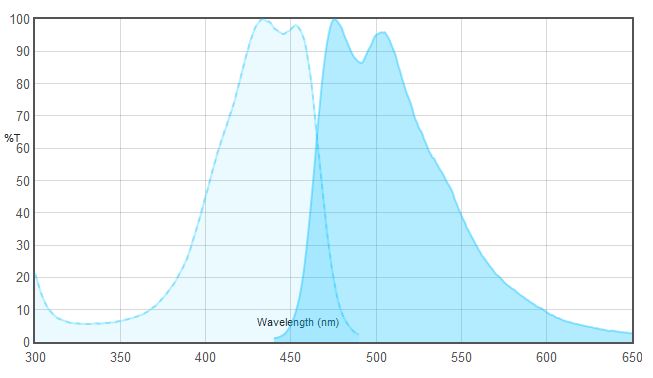
CFP

Spectrum Chart

Excitation (㎚) Emission (㎚)
433 475

Recommended Filter set

  • 일반 형광 Lighting source

Filter Model No. Excitation filter (㎚) Dichroic mirror (㎚) Emission filter (㎚) Remarks
39001 435/20
(425~445)
455 (LP) 480/30
(465~495)
Narrow Excitation band,
Bandpass Emission
49001 436/20
(426~446)
455 (LP) 480/40
(460~500)
Narrow Excitation band,
Bandpass Emission
  • 레이저 Lighting source 

Filter Model No. Excitation filter (㎚) Dichroic mirror (㎚) Emission filter (㎚) Remarks
49902 436/20
(426~446)
442 (LP) 480/40
(460~500)
For use with laser between 430-445㎚

Narrow Excitation band,
Bandpass Emission

49903 436/20
(426~4460)
442 (LP) 500/40
(480~520)
For use with laser between 430-445㎚

Narrow Excitation band,
Bandpass Emission

Information

Cyan Fluorescent Protein (CFP) is a versatile biological marker for monitoring physiological processes, visualizing protein localization, and detecting transgenic expression in vivo. CFP can be excited by the 405 ㎚laser line and is optimally detected at 485 ㎚.

시안 형광 단백질 (Cyan Fluorescent Protein, CFP)은 생리 학적 과정을 모니터링하고, 단백질의 위치를 시각화하며, 생체 내에서 유전자 변형 (transgenic expression)을 검출하는 다목적 생물학적 표지자로서 CFP는 405 nm 레이저 라인에 의해 여기 될 수 있으며 485 ㎚에서 최적으로 검출됩니다.
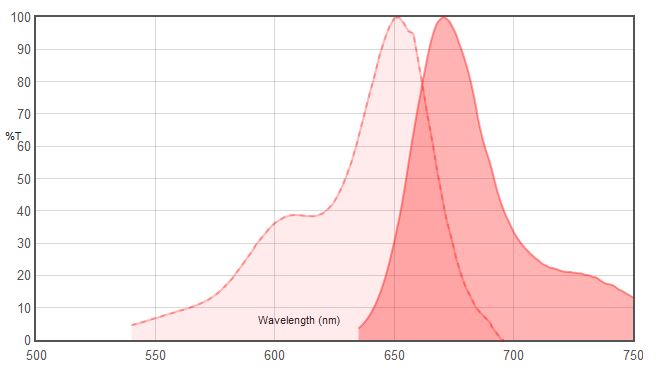
Cy5

Spectrum Chart

Excitation (㎚) Emission (㎚)
649 670

Recommended Filter set

  • 일반 형광 Lighting source

Filter Model No. Excitation filter (㎚) Dichroic mirror (㎚) Emission filter (㎚) Remarks
JNO-R2(B) 620/50
(595~645)
655 (LP) 690/50
(665~715)
Wide Excitation band,
Bandpass Emission
49006 620/60
(590~650)
660 (LP) 700/75
(662.5~737.5)
Very Wide Excitation band,
Bandpass Emission
49009 640/30
(625~655)
660 (LP) 690/50
(665~715)
Medium Excitation band,
Bandpass Emission

  • 레이저 Lighting source 

Filter Model No. Excitation filter (㎚) Dichroic mirror (㎚) Emission filter (㎚) Remarks
49913 635/20
(625~645)
640 (LP) 655(LP) For use with laser between 627~643㎚

Narrow Excitation band,
Longpass Emission

49914 642/20
(632~652)
647 (LP) 705/72
(669~741)
For use with laser between 633~650㎚

Narrow Excitation band,
Bandpass Emission

Information

Cy5 dye is a bright, far-red-fluorescent dye that can be excited using the 633 or 647 ㎚ laser lines, and visualized Cy5 filter sets.  In addition to immunocytochemistry applications, Cy5 is also commonly used to label nucleic acids.

Cy5 염료는 633 또는 647 ㎚ 레이저 라인을 사용하여 여기되고 Cy5 필터 세트를 시각화 할 수있는 밝은 원색 – 형광 염료로서 면역 세포 화학 응용뿐만 아니라 핵산 표지에도 일반적으로 사용됩니다.

AlexaFluor 594

Spectrum Chart

Excitation (㎚) Emission (㎚)
590 617

Recommended Filter set

  • 일반 형광 Lighting source

Filter Model No. Excitation filter (㎚) Dichroic mirror (㎚) Emission filter (㎚) Remarks
JNO-R1(B) 560/40
(540~580)
600 (LP) 635/60
(605~665)
Wide Excitation band,
Bandpass Emission
49008 560/40
(540~580)
600 (LP) 630/75
(592.5~667.5)
Wide Excitation band,
Bandpass Emission
49306 580/25
(567.5~592.5)
600 (LP) 625/30
(610~640)
Narrow Excitation band,
Bandpass Emission

  • 레이저 Lighting source 

Filter Model No. Excitation filter (㎚) Dichroic mirror (㎚) Emission filter (㎚) Remarks
49911 594/10
(589~599)
594 (LP) 645/75
(607.5~682.5)
Narrow Excitation band,
Bandpass Emission

Information

Alexa Fluor 594 dye is a bright, red-fluorescent dye that can be excited using the 561 ㎚ or 594 ㎚ laser lines. For stable signal generation in imaging and flow cytometry, Alexa Fluor 594 dye is pH-insensitive over a wide molar range.

Alexa Fluor® 594 염료는 561  또는 594 ㎚ 레이저 라인을 사용하여 여기 될 수있는 밝은 적색 형광 염료입니다. 이미징 및 유동 세포 계측법에서 안정적인 신호 생성을 위해 Alexa Fluor® 594 염료는 넓은 molar 농도 범위에서 pH에 둔감합니다.

TRITC

Spectrum Chart

Excitation (㎚) Emission (㎚)
555 580

Recommended Filter set

  • 일반 형광 Lighting source 사용시

Filter Model No. Excitation filter (㎚) Dichroic mirror (㎚) Emission filter (㎚) Remarks
JNO-G(B) 540/25
(527.5~552.5)
565 (LP) 605/55
(577.5~632.5)
Narrow Excitation band,
Bandpass Emission
49004 545/25
(532.5~557.5)
565 (LP) 605/70
570~640)
Narrow Excitation band,
Bandpass Emission
49305 546/22
(535~557)
565 (LP) 590/33
(573.5~606.5)
Narrow Excitation band,
Bandpass Emission

  • 레이저 Lighting source 사용시

Filter Model No. Excitation filter (㎚) Dichroic mirror (㎚) Emission filter (㎚) Remarks
49908 532/10
(527~537)
532 (LP) 590/50
(565~615)
For use with laser between 529~535㎚

Very Narrow Excitation band,
Bandpass Emission

49909 561/10
(556~566)
561 (LP) 600/50
(575~625)
For use with laser between 557~563㎚

Narrow Excitation band,
Bandpass Emission

Information

Tetramethylrhodamine (TRITC) is a bright orange-fluorescent dye with excitation ideally suited to the 532 ㎚ laser line. It is commonly conjugated to antibodies and proteins for cellular imaging applications.

Tramethylrhodamine (TRITC)은 532 ㎚ 레이저 라인에 이상적으로 적합한 여기가있는 밝은 주황색 형광 염료로서 일반적으로 세포 이미징 응용을위한 항체와 단백질에 접합됩니다.

FITC

Spectrum Chart

Excitation (㎚) Emission (㎚)
490 525

Recommended Filter

  • 일반 형광 Lighting source 사용시

Filter Model No. Excitation filter (㎚) Dichroic mirror (㎚) Emission filter (㎚) Remarks
JNO-B(B) 480/30
(465~495)
505 (LP) 535/40
(515~555)
Medium Excitation band,
Bandpass Emission
49002 470/40
(450~490)
495 (LP) 525/50
(500~550)
Wide Excitation band,
Bandpass Emission
49011 480/40
(460~500)
510 (LP) 535/50
(510~560)
Wide Excitation band,
Bandpass Emission
  • 레이저 Lighting source 사용시

Filter Model No. Excitation filter (㎚) Dichroic mirror (㎚) Emission filter (㎚) Remarks
49904 488/10
(483~493)
488 (LP) 525/50
(500~550)
For use with laser between 485~491㎚

Very Narrow Excitation band,
Bandpass Emission

Information

Fluorescein isothiocyanate (FITC) is a derivative of fluorescein used in wide-ranging applications including flow cytometry. FITC is the original fluoresce in molecule functionalized with an isothiocyanate reactive group (-N=C=S), replacing a hydrogen atom on the bottom ring of the structure. This derivative is reactive towards nucleophiles including amine and sulfhydryl groups on proteins.

A succinimidyl-ester functional group attached to the fluorescein core, creating “NHS-fluorescein”, forms another common amine reactive derivative that has much greater specificity toward primary amines in the presence of other nucleophiles.

FITC has excitation and emission spectrum peak wavelengths of approximately 495 ㎚ /519 ㎚. Like most fluorochromes, it is prone to photobleaching. Because of the problem with photobleaching, derivatives of fluorescein such as Alexa 488 and DyLight 488 have been tailored for various chemical and biological applications where greater photostability, higher fluorescence intensity, or different attachment groups are needed.

Fluorescein isothiocyanate (FITC)는 유동 세포 계측법을 포함한 광범위한 응용 분야에서 사용되는 fluorescein의 유도체입니다. FITC는 이소 티오 시아 네이트 반응기 (-N = C = S)로 관능화된 원래의 플루오 레세 인 분자로 구조의 바닥 링상의 수소 원자를 대체합니다. 이 유도체는 단백질상의 아민 및 설프 하이 드릴 그룹을 포함하는 친핵체에 대한 반응성입니다.

“NHS- 플루 오레 신”을 생성하는 플루오 레세인 코어에 부착된 숙신 이미 딜 – 에스테르 작용기는 다른 친핵체 존재하에서 제 1 급 아민에 대해 훨씬 더 큰 특이성을 갖는 또 다른 통상적 인 아민 반응성 유도체를 형성합니다.

FITC는 약 495 ㎚ / 519 ㎚ 의 여기 및 방출 스펙트럼 피크 파장을 갖습니다. 대부분의 fluorochromes 처럼, 그것은 photobleaching하는 경향이 있습니다. photobleaching 의 문제로 인해 Alexa 488과 DyLight 488과 같은 fluorescein의 유도체는 광 안정성, 형광 강도 또는 다른 부착 그룹이 필요한 다양한 화학 및 생물학적 응용 분야에 맞춰졌습니다.


If you need more information for recommended filter sets, please click the model No. If you can’t click it, please contact us.

DAPI

Spectrum Chart

DAPI Spectrum
Excitation (㎚)Emission (㎚)
359461

Recommended Filter set

  • 일반 형광 Lighting source
Filter Model No.Excitation filter (㎚)Dichroic mirror (㎚)Emission filter (㎚)Remarks
JNO-U(B)375/28
(361-389)
415 (LP)460/50
(435-485)
Narrow Excitation band,
Bandpass Emission
49000350/50
(325-375)
400 (LP)460/50
(435-485)
Wide Excitation band,
Bandpass Emission
49028395/25
(382.5-407.5)
425 (LP)460/50
(435-485)
For 395㎚ light sources Narrow Excitation band,
Bandpass Emission
  • 레이저 Lighting source -> 문의 주시기 바랍니다.

Information

DAPI (4′,6-diamidino-2-phenylindole) is a fluorescent stain that binds strongly to A-T rich regions in DNA. It is used extensively in fluorescence microscopy. As DAPI can pass through an intact cell membrane, it can be used to stain both live and fixed cells, though it passes through the membrane less efficiently in live cells and therefore the effectiveness of the stain is lower.

DAPI (4 ‘, 6-diamidino-2-phenylindole)는 DNA의 A-T가 풍부한 부위에 강하게 결합하는 형광 염료입니다. 그것은 형광 현미경에서 광범위하게 사용됩니다. DAPI는 손상되지 않은 세포막을 통과 할 수 있기 때문에 살아있는 세포에서 덜 효율적으로 막을 통과하기 때문에 살아있는 세포와 고정 된 세포를 모두 염색하는 데 사용할 수 있으므로 얼룩 효과는 낮습니다.