J.H.JIN의 모든 글

49002

Chroma Filter 49002

49002 Spectrum

Chroma_49002
Chroma_49002
FiltersType
ET470/40xEX
 T495lpxrBS
ET525/50mEM

– Filter set for EGFP (FITC/Cy2)

  • Main Fluorochromes : GFP
Excitation (㎚)Emission (㎚)
488507

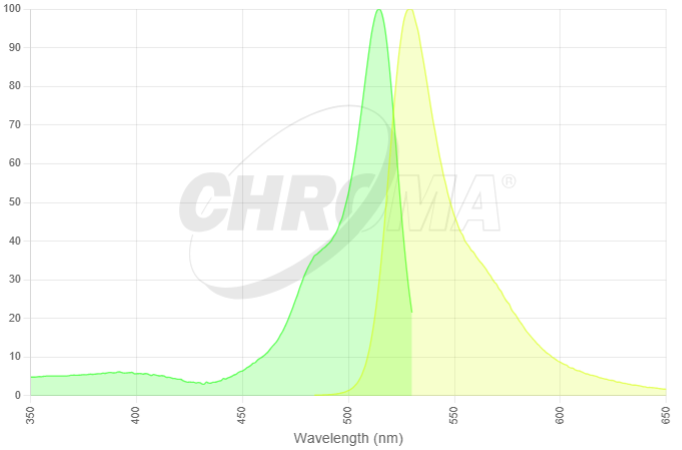
Spectrum Comparison Fluor and 49002

GFP VS 49002
GFP VS 49002

Best with these fluorochromes

49002 Spec

  • Typical Application(s) : Widefield Microscopy
  • Coating : Sputter/Hard Coated
  • Round excitation and emission filters mounted in anodized aluminum rings 2.3mm or 3.5mm thick, up to 25mm in diameter
  • Rectangular dichroics up to 26x38mm or 25.5×36, 1mm thick, to fit standard microscope manufacturer filter cubes

39009

Chroma Filter 39009

39009 Spectrum

Chroma_39009
Chroma_39009
FiltersType
AT480/30xEX
 AT505DCBS
AT620/60mEM

– Filter set for Acridine Orange/Di-8-ANEPPS

  • Main Fluorochromes : EtBr
Excitation (㎚)Emission (㎚)
520603

Spectrum Comparison Fluor and 39009

EtBr VS 39009
EtBr VS 39009

Best with these fluorochromes

  • Acridine Orange + RNA
  • Di-8-ANEPPS non-ratiometric
  • DiA
  • Ethidium Bromide
  • FM™ 1-43
  • LysoTracker Yellow HCK-123
  • Pulsar™ 650

39009 Spec

  • Typical Application(s) : Widefield Microscopy
  • Coating : Sputter/Hard Coated
  • Round excitation and emission filters mounted in anodized aluminum rings 2.3mm or 3.5mm thick, up to 25mm in diameter
  • Rectangular dichroics up to 26x38mm or 25.5×36, 1mm thick, to fit standard microscope manufacturer filter cubes

39003

Chroma Filter 39003

39003 Spectrum

Chroma_39003
Chroma_39003
FiltersType
AT495/20xEX
 AT515DCBS
AT540/30mEM

– Filter set for EYFP/Venus/Citrine

  • Main Fluorochromes : EYFP
Excitation (㎚)Emission (㎚)
514527

Spectrum Comparison Fluor and 39003

EYFP VS 39003
EYFP VS 39003

Best with these fluorochromes

39003 Spec

  • Typical Application(s) : Widefield Microscopy
  • Coating : Sputter/Hard Coated
  • Round excitation and emission filters mounted in anodized aluminum rings 2.3mm or 3.5mm thick, up to 25mm in diameter
  • Rectangular dichroics up to 26x38mm or 25.5×36, 1mm thick, to fit standard microscope manufacturer filter cubes

39001

JNOPTIC Filter 39001

Download Catalog_39001

39001 Spectrum

FiltersType
AT435/20xEX
 AT455DCBS
AT480/30mEM

– Filter set for ECFP/Cerulean

  • Main Fluorochromes : CFP
Excitation (㎚)Emission (㎚)
433475

Spectrum Comparison Fluor and 39001

CFP VS 39001
CFP VS 39001

Best with these fluorochromes

  • AmCyan
  • Atto 425
  • Cerulean
  • CFP
  • ECFP

39001 Spec

  • Typical Application(s) : Widefield Microscopy
  • Coating : Sputter/Hard Coated
  • Round excitation and emission filters mounted in anodized aluminum rings 2.3mm thick, up to 25mm in diameter
  • Rectangular dichroics up to 26x38mm, 1mm thick, to fit standard microscope manufacturer filter cubes

Cy5.5

Spectrum Chart

Cy5.5 Spectrum

Excitation (㎚) Emission (㎚)
675 695

Recommended Filter set

  • 일반 형광 Lighting source

Filter Model No. Excitation filter (㎚) Dichroic mirror (㎚) Emission filter (㎚) Remarks
49022 545/25
(532.5~557.5)
565 (LP) 605/70
(570~640)
Narrow Excitation band,
Bandpass Emission

  • 레이저 Lighting source 

Filter Model No. Excitation filter (㎚) Dichroic mirror (㎚) Emission filter (㎚) Remarks
49914 642/20
(632~652)
647 (LP) 705/72
(669~741)
For use with laser between 633~650㎚

Narrow Excitation band,
Bandpass Emission

Information

A variety of cyanine 5.5 (Cy5.5) dyes has been used to label biological molecules for fluorescence imaging and other fluorescence-based biochemical analysis. They are widely used for labeling peptides, proteins and oligos etc. Cy5.5 dyes are one type of the most common red fluorophores.

Cyanine 5.5 (Cy5.5) 염료는 형광 이미징 및 기타 형광 기반 생화학 분석을 위해 생물 분자를 표지하는 데 사용되었습니다. 그들은 펩타이드, 단백질 및 올리고 제 등의 라벨링에 널리 사용됩니다. Cy5.5 염료는 가장 일반적인 적색 형광체의 한 유형입니다.

tdTomato

Spectrum Chart

Excitation (㎚) Emission (㎚)
554 581

Recommended Filter set

  • 일반 형광 Lighting source

Filter Model No. Excitation filter (㎚) Dichroic mirror (㎚) Emission filter (㎚) Remarks
JNO-G(B) 540/25
(527.5~552.5)
565 (LP) 605/55
(577.5~632.5)
Narrow Excitation band,
Bandpass Emission
49004 545/25
(532.5~557.5)
565 (LP) 605/70
570~640)
Narrow Excitation band,
Bandpass Emission
49305 546/22
(535~557)
565 (LP) 590/33
(573.5~606.5)
Narrow Excitation band,
Bandpass Emission

  • 레이저 Lighting source 

Filter Model No. Excitation filter (㎚) Dichroic mirror (㎚) Emission filter (㎚) Remarks
49908 532/10
(527~537)
532 (LP) 590/50
(565~615)
For use with laser between 529~535㎚

Narrow Excitation band,
Longpass Emission

49909 561/10
(556~566)
561 (LP) 600/50
(575~625)
For use with laser between 557~563㎚

Narrow Excitation band,
Bandpass Emission

Information

tdTomato is a genetic fusion of two copies of the dTomato gene (2) which was specifi cally designed for low aggregation. Its tandem dimer structure plays an important role in the exceptional brightness of tdTomato. Its excitation and emission maxima occur at 554 ㎚ and 581 ㎚, respectively. Because tdTomato forms an intramolecular dimer, it behaves like a monomer, and has been used successfully for N- and C- terminal fusions. It shows excellent photostability and its half-time (t0.5) for maturation is one hour at 37°C.

EYFP

Spectrum Chart

EYFP Spectrum
EYFP Spectrum
EX(㎚)EM(㎚)
514527

Recommended Filter set

  • 일반 형광 Lighting source
Filter Model No.Excitation filter (㎚)Dichroic mirror (㎚)Emission filter (㎚)Remarks
39003495/20
(485~505)
515 (LP)535/30
(520~550)
Narrow Excitation band,
Bandpass Emission
49003500/20
(490~510)
515 (LP)540/30
(525~555)
Narrow Excitation band,
Bandpass Emission
  • 레이저 Lighting source 
Filter Model No.Excitation filter (㎚)Dichroic mirror (㎚)Emission filter (㎚)Remarks
49905514/10
(509~519)
514 (LP)545/40
(525~565)
For use with laser between 511~517㎚ Narrow Excitation band,
Bandpass Emission

Information

Yellow fluorescent protein (YFP) is a genetic mutant of green fluorescent protein (GFP) originally derived from the jellyfish Aequorea victoria. Its excitation peak is 514 ㎚ and its emission peak is 527 ㎚. Like the parent GFP, YFP is a useful tool in cell and molecular biology thanks to its properties useful for fluorescence microscopy.

노란색 형광 단백질 (YFP)은 원래 해파리 Aequorea victoria에서 파생 된 녹색 형광 단백질 (GFP)의 유전 적 돌연변이입니다. 그것의 여기 피크는 514 ㎚이고 방출 피크는 527 ㎚ 입니다. 부모 GFP와 마찬가지로 YFP는 형광 현미경 검사에 유용한 그 특성 덕분에 세포 및 분자 생물학에서 유용한 도구입니다.

GFP

Spectrum chart

GFP Spectrum

Excitation (㎚) Emission (㎚)
488 507

Recommended Filter set

  • 일반 형광 Lighting source

Filter Model No. Excitation filter (㎚) Dichroic mirror (㎚) Emission filter (㎚) Remarks
JNO-B(B) 480/30
(465~495)
505 (LP) 535/40
(515~555)
Medium Excitation band,
Bandpass Emission
49002 470/40
(450~490)
495 (LP) 525/50
(500~550)
Wide Excitation band,
Bandpass Emission
49020 480/20
(470~490)
495 (LP) 510/20
(500~530)
Narrow Excitation band,
Bandpass Emission

  • 레이저 Lighting source 

Filter Model No. Excitation filter (㎚) Dichroic mirror (㎚) Emission filter (㎚) Remarks
49904 488/10
(483~493)
488 (LP) 525/50
(500~550)
For use with laser between 485~491㎚

Narrow Excitation band,
Bandpass Emission

Information

The green fluorescent protein (GFP) is a protein composed of 238 amino acid residues (26.9 kDa) that exhibits bright green fluorescence when exposed to light in the blue to ultraviolet range. Although many other marine organisms have similar green fluorescent proteins, GFP traditionally refers to the protein first isolated from the jellyfish Aequorea victoria. The GFP from A. victoria has a major excitation peak at a wavelength of 395 ㎚ and a minor one at 475 ㎚. Its emission peak is at 509 ㎚, which is in the lower green portion of the visible spectrum.

녹색 형광 단백질 (GFP)은 238 아미노산 잔기 (26.9 kDa)로 구성된 단백질로 청색에서 자외선까지의 빛에 노출되면 밝은 녹색 형광을 나타냅니다. 많은 다른 해양 생물이 유사한 녹색 형광 단백질을 가지고 있지만, GFP는 전통적으로 해파리 Aequorea victoria에서 먼저 분리 된 단백질을 의미합니다. A. 빅토리아의 GFP는 파장 395 ㎚ 에서 주요한 여기 피크와 475 ㎚ 에서 사소한 피크를 나타내고 그 방출 피크는 가시 광선 스펙트럼의 낮은 녹색 부분에 있는 509 ㎚ 입니다.

EtBr

Spectrum Chart

Excitation (㎚) Emission (㎚)
520 603

Recommended Filter set for for EtBr

  • 일반 형광 Lighting source

Filter Model No. Excitation filter (㎚) Dichroic mirror (㎚) Emission filter (㎚) Remarks
39009 480/30
(465~495)
505 (LP) 620/60
(590~650)
Medium Excitation band,
Bandpass Emission
49005 545/30
(530~560)
570 (LP) 620/60
(590~650)
Medium Excitation band,
Bandpass Emission

  • 레이저 Lighting source -> 문의 주시기 바랍니다.

Information

As with most fluorescent compounds, ethidium bromide is aromatic. Its core heterocyclic moiety is generically known as a phenanthridine, an isomer of which is the fluorescent dye acridine. Absorption maxima of EtBr in aqueous solution are at 210 ㎚ and 285 ㎚, which correspond to ultraviolet light. As a result of this excitation, EtBr emits orange light with wavelength 605 ㎚.

대부분의 형광 화합물과 마찬가지로 에티듐 브로마이드는 방향족으로  중심 헤테로시 클릭 잔기는 페난 트리 딘으로 일반적으로 알려져 있으며, 이의 이성질체는 형광 염료 아 크리 딘입니다. 수용액에서의 EtBr의 흡수 최대 값은 210 ㎚ 와 285 ㎚ 에서 자외선에 해당하며 이 여기의 결과로 EtBr은 파장 605 ㎚ 의 주황색 광을 방출합니다.

Cy7

Spectrum Chart

Cy7 Spectrum

Excitation (㎚) Emission (㎚)
743 767

Recommended Filter set

  • 일반 형광 Lighting source

Filter Model No. Excitation filter (㎚) Dichroic mirror (㎚) Emission filter (㎚) Remarks
49007 710/75
(672.5~747.5)
760 (LP) 810/90
(765~855)
Very Wide Excitation band,
Bandpass Emission
  • 레이저 Lighting source -> 문의 주시기 바랍니다.

Information

Cyanines were and are still used in industry, and more recently in biotechnology (labeling, analysis). Cyanines have many uses as fluorescent dyes, particularly in biomedical imaging. Depending on the structure, they cover the spectrum from IR to UV.

Cyanine is the non-systematic name of a synthetic dye family belonging to polymethine group. The word cyanin is from the English word “cyan”, which conventionally means a shade of blue-green (close to “aqua”) and is derived from the Greek κυάνεος/κυανοῦς kyaneos/kyanous which means a somewhat different color: “dark blue”.

Cy7 is a near-IR fluor that is invisible to the naked eye (Excitation/emission maximum 750/776 ㎚). It is used in in vivo imaging applications, as well as the Cy7.5 dye.

Cyanines(Cy) replace advantageously conventional dyes such as Fluorescein(FITC) and rhodamines (TRITC, RRX), yielding brighter and more stable fluorescence.

시아닌은 여전히 업계에서, 그리고 최근에는 생명 공학 (라벨링, 분석)에서 사용되고 있습니다. 시아닌은 형광 염료로서, 특히 생체 의학 이미징에서 많은 용도로 사용되며 구조에 따라 IR에서 UV까지 스펙트럼을 커버합니다.

Cyanine은 polymethine 그룹에 속하는 합성 염료 계열의 비 계통적 이름입니다. cyanin이라는 단어는 일반적으로 청록색 ( “아쿠아”에 가까운)의 그늘을 의미하는 영어 단어 “cyan”에서 유래되었으며 다소 다른 색상 “진한 파란색 “을 의미하는 그리스어 κυάνεος / κυανοῦς kyaneos / kyanous에서 파생되었습니다.

Cy7은 육안으로 보이지 않는 근적외선 (near-IR) 불소로서 (여기 / 방출 최대 750/776 ㎚) Cy7.5 염료뿐만 아니라 생체 내 이미징 응용 프로그램에 사용됩니다.

Cyanines (Cy)는 Fluorescein (FITC) 및 rhodamines (TRITC, RRX)와 같은 기존의 염료를 대체하여 보다 밝고 안정한 형광을 생성합니다.